The Calabash and the Ballot Box
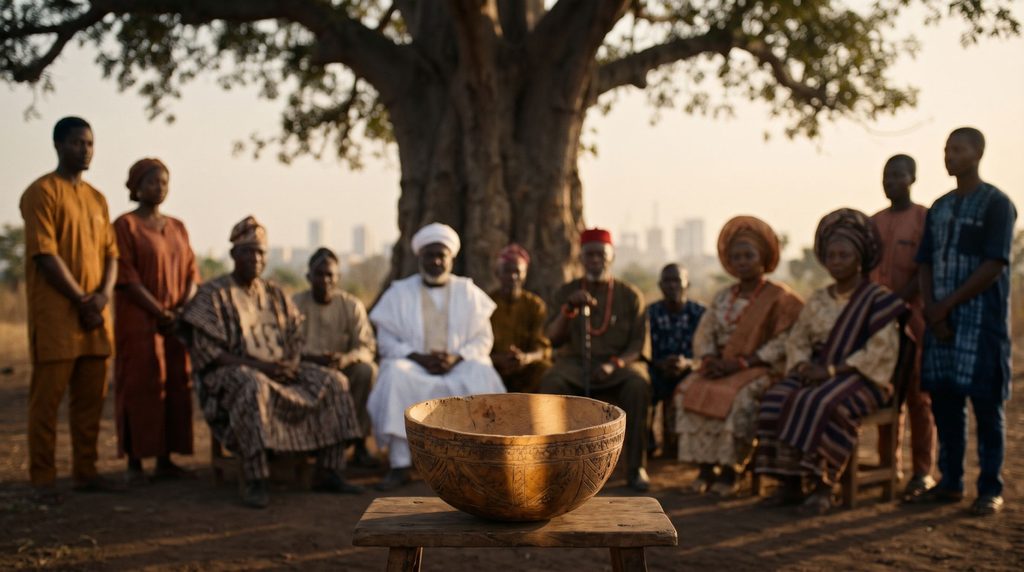
Nigeria does not need to choose between democracy and dictatorship. It needs to remember that it once had something else.
In old Ọ̀yọ́, the most powerful man in the empire could be removed with a gift.
When the Aláàfin abused his office, the council of the Ọ̀yọ́ Mèsì did not raise an army or rig a vote. They sent him an empty calabash. The meaning was understood by everyone, from the palace to the farthest farm: the people have withdrawn their consent. The king’s authority ended that day.
The ritual that followed was harsh, and nobody should want it back. But look at what sat underneath it. A ruler held power on loan. The people who chose him were not the only people who could remove him. And removal was not a coup or a crisis. It was a procedure everyone knew existed, which meant every Aláàfin governed knowing it could be used.
That idea was not unique to the Yoruba. Igbo towns governed themselves with no king at all, through open assemblies where any grown man could speak and women’s councils could shut down a village until wrongs were put right. The Sokoto Caliphate kept its judges independent of its emirs and required rulers to consult before acting. The Tiv made unexplained wealth a matter of public suspicion. The Efik built a society, Ekpe, that enforced debts across every family line and answered to none of them.
These were working systems of checks and balances, built on this soil, by these peoples, long before anyone in London drew the borders of a country called Nigeria.
We set most of them aside. This post asks a simple question: what if we picked them back up?
Borrowed clothes
Since 1960, Nigeria has tried a Westminster parliament, an American-style presidency, and long stretches of military rule. Each arrived with a promise. Each left most Nigerians asking the same question: who is this government actually answerable to?
The honest answer, too often, is the people who paid for it. Elections have become auctions. A governor can spend years in office without a single public accounting of what he promised and what he delivered. Local governments, the tier closest to ordinary life, receive money that rarely reaches them. Traditional rulers, who once checked power, are now appointed, promoted and deposed by the state governments they were meant to restrain.
The problem is not that Nigerians are unfit for good government. The problem is that the systems we inherited kept the throne and threw away the ring of institutions that once surrounded it. A president with a four-year term and a loyal party has very little to fear between elections. An Aláàfin facing the Ọ̀yọ́ Mèsì, the Ògbóni and the Iyalode had a great deal to fear every single day.
So instead of asking which foreign model to try next, I started from a different place. What did the original peoples of this land rely on to keep leaders honest, and can those mechanisms work at the scale of 230 million people?
The proposal, in plain terms
I call it Àṣẹ-Ìgbìmọ̀, roughly “mandate under council.” The name is a working title; a system meant for all of Nigeria should eventually be named by all of Nigeria. Here is how it works.
Every office is a loan. Power belongs to the community. A leader holds it only for as long as the community allows, and the constitution spells out exactly how it can be taken back.
Five functions, at every level. From the ward to the federation, every tier of government has the same five parts: a Head who runs things; Kingmakers who shortlist candidates and can rebuke or remove; Truth-Keepers who audit the books and administer oaths; an Assembly with separate chambers for residents, women and youth; and independent judges. Each is chosen through a different route, so no single faction can capture all five.
Nobody runs for office. You cannot nominate yourself. Three independent bodies that know you (your ward, your age grade or guild, the women’s council) must put you forward. You then sit for a public truth hearing where anyone can speak for or against you, and you answer under oath. The best candidates are shortlisted on published scores. The final choice among them is made by a public, verifiable lot, weighted by the Assembly’s preferences. Think of it as the modern version of consulting Ifá or the oracle: once everyone in the draw is fit, the last step is taken out of the hands of money.
You swear to specific promises. Before taking office, the leader files a covenant: a handful of measurable, costed goals tied to the community’s own priorities. Twelve health centres working, not “improved healthcare.” Eighteen kilometres of market road, not “infrastructure.” They swear on these goals, on the faith of their choosing (Qur’an, Bible, Ògún’s iron, Amadioha or their ancestors), and they post a bond from their own assets.
Every year, a Day of Account. On the community’s own festival, whether New Yam, Durbar, Ọ̀ṣun or Ofala, the leader stands before the people and reports goal by goal. Age grades, who have always built and watched over community projects, act as monitors and give their own verdict. Missed goals trigger consequences that climb a ladder: private warning, public rebuke, a truth hearing, suspension, and finally the empty calabash.
Diversity is the design, not the problem. An Igbo town can stay republican. An emirate can keep its emir. A Yoruba town can keep its oba. The constitution does not dictate the form, only the floor: all five functions must exist, women must hold real power, no one can be excluded by caste, faith or settler status, and every leader must be removable. Nigeria’s 250-plus peoples become 250-plus tested ideas about how to govern well.
One term, and you leave no richer. Single terms remove the incentive to spend the first four years campaigning for the next four. Assets are checked on entry, every year in office, and for five years after leaving. Unexplained wealth is presumed stolen until shown otherwise.
At the federal level, headship rotates across the six geopolitical zones, a Council of Peoples gives every cultural nation a seat, and decisions that touch language, religion or land need agreement from both chambers, not just a bare majority.
For the sceptics
If you are already raising objections, good. A system that cannot survive hard questions does not deserve a hearing. Here are the ones I hear most, and my best answers.
“This is romanticising the past.” Pre-colonial societies also practised slavery, trial by ordeal, caste exclusion and, in places, human sacrifice. Many shut women out of formal office. Nothing here brings any of that back. The proposal keeps the mechanisms (removal by procedure, separated powers, public accounting) and discards the societies that surrounded them. Fundamental rights override any custom, full stop.
“Choosing leaders by lot is gambling with the nation.” Only people who have already passed nomination, a public hearing and a merit shortlist enter the draw, so every possible outcome is a qualified leader. What the lot removes is the ability to buy the result. Ancient Athens used it. Venice used it for centuries to choose its Doge. Our own ancestors used divination for the same purpose: to take the final choice out of human scheming.
“Nobody fears Ògún anymore. Oaths are theatre.” Partly true, and the design assumes it. The sacred oath is a layer, not the lock. The lock is worldly: a bond you lose, assets checked for years after you leave, spending published within a week, and a removal process that actually works. The faith layer adds weight for those who believe. The civic layer binds everyone else.
“Without parties, how do ideas compete?” Associations can still argue, publish and campaign for policies. They simply cannot nominate, fund or whip office-holders. Ideas compete in the covenants and on the Day of Account. What disappears is the machine that turns ethnic blocs and money into votes.
“The same elites will capture it.” This is the most serious objection, and it is the one I lose sleep over. The defence is layered: kingmakers can shortlist but never choose, the lot makes purchases unreliable, the Assembly can dissolve a captured council, and ordinary residents can force a recall on their own. No design is capture-proof. This one is built to make capture expensive, visible and reversible.
“It’s a Yoruba idea dressed up for everyone.” It isn’t, and if it ever becomes one it will fail. The mechanisms come from Igbo assemblies, Sokoto’s courts, Tiv lineages, Efik societies, Kanem-Bornu’s councils and women’s institutions across the country. A national design process would have to be led by all of them.
Where this starts
None of this requires tearing anything down tomorrow. In fact, it shouldn’t.
The first test needs no constitutional amendment at all. Town unions, market associations and community development associations already manage real money and real projects across Nigeria. Any of them could adopt the covenant, the truth hearing, the public ledger and the Day of Account next year. If the idea works, the results will show up in roads finished and money accounted for. If it doesn’t, we will learn why, cheaply, before anyone stakes a nation on it.
From there the path runs upward: willing local governments, then willing states, and only then, with years of evidence in hand, the National Assembly. That is how the idea earns its way, the same way any leader in this system would have to.
I am not offering a finished answer. I am offering a starting point and asking for help to break it, improve it and test it. I especially want to hear from people outside my own tradition: northern scholars, Igbo community leaders, Middle Belt and Niger Delta voices, market women, young people who have never seen a government keep a promise.
Our ancestors understood something we have forgotten. Power that cannot be taken back will always be abused. The calabash was never really about the king. It was about the people remembering that the authority had been theirs all along.
Tell me where this is wrong. Tell me what your own people did. Let’s build it together.
This is so so so profound. There will always be naysayers, but all good. Well done.