Operating Cloud Infrastructure at the Speed of Intent: The 90-Day Agentic Shift
For the past decade, the holy grail of DevOps and platform engineering has been automation. We wrote bash scripts, compiled complex Jenkins pipelines, and eventually moved toward declarative states with Terraform or OpenTofu. Yet, even with Infrastructure as Code (IaC), a structural bottleneck remained: the human. Engineers still manually analyse logs, approve PRs, triage alerts, and decide when to scale clusters.
We are currently living through a profound architectural pivot. As explored in Agentic Coding: Operating Cloud Infrastructure at the Speed of Intent, software engineering is shifting from manual construction to supervised autonomy. The core job of a DevOps engineer is no longer implementing tasks sequentially; it is designing, guiding, and governing autonomous agentic systems that execute loops based on high-level intent.
But how do you take an enterprise cloud footprint — where a single misconfiguration can result in catastrophic downtime or a massive blast radius — and hand control over to an AI agent?
You do not do it overnight. You do it via a structured, predictable 90-day framework.
The Anatomy of an Agentic Loop
To move away from rigid scripts, we must understand how an agent actually operates. Traditional automation is linear: if X happens, execute Y. If Y fails, fail the build.
An agentic system operates dynamically using an intentional, continuous cycle: Plan → Act → Observe → Retry.
- Plan: The agent accepts a high-level goal (e.g., “Optimise cluster spend without breaching 99.9% availability”), evaluates the current environment context, and formulates a series of sequential tasks.
- Act: It executes the next logical step in its plan — whether that is running an IaC script, modifying a manifest, or spinning up a transient testing sandbox.
- Observe: Crucially, the agent checks the deterministic output of its action against objective success criteria.
- Retry: If the check fails, the agent does not simply crash. It reads the error log, adjusts its context parameters, and loops back to formulate an updated plan.
The 3-Phase Transformation Arc
Making this paradigm shift requires moving through three distinct operational phases. This ensures that safety, alignment, and risk engineering mature at the exact same speed as the agent’s capabilities.
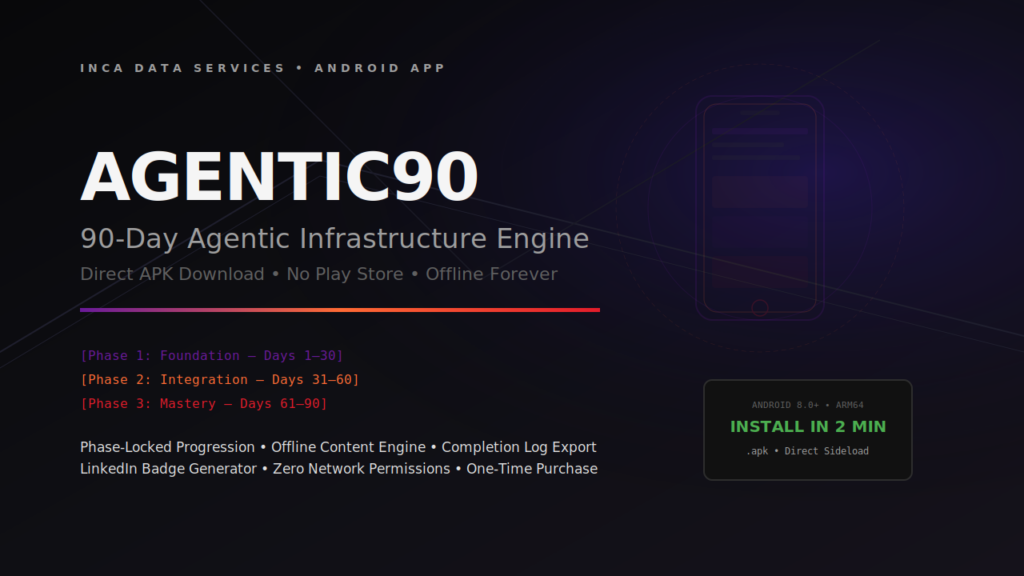
Phase 1: Foundation (Days 1–30)
Before letting an agent touch production, you must establish an explicit baseline. This phase focuses on mapping automation candidates, identifying institutional memory, and defining strict boundaries. You shift your professional identity from a manual developer to a systems architect. This is where you draft your first Agent Mandate — a markdown document detailing a specific role, goal, environmental limitations, and unambiguous escalation points.
Phase 2: Integration (Days 31–60)
Here, you introduce agents to active environments, protected by Approval Gates (AGENT_GATES.md). Instead of letting an agent auto-apply infrastructure variations unilaterally, it proposes modifications to a human gatekeeper. You implement multi-agent workflows, model security blast radii, and tag code provenance to guarantee absolute system auditability.
Phase 3: Mastery (Days 61–90)
In the final phase, you move to true scale. Systems transition to automated self-healing frameworks, where an agent triages and resolves specific tier-1 production outages autonomously, alongside continuously active cloud-cost optimisation agents. You establish architectural decision records (ADRs) that treat agents as first-class operational nodes.
The Guardrail Matrix: Engineering the Blast Radius
One of the defining principles of Agentic Coding is that a boundary an agent is asked to respect is a boundary an attacker can talk it across. Governance cannot be passive; it must be built into the architectural pipeline.
To safely implement agentic architectures, engineers must grade every candidate workflow across a deterministic Risk Matrix before assigning an agent loop to it:
| Operational Dimension | Low Risk Pattern | High Risk Pattern |
|---|---|---|
| Task Nature | Execution-only, deterministic rules | High qualitative human judgment required |
| Blast Radius | Air-gapped dev environment, low compute | Production cluster, identity/access control panels |
| Outcome Verifiability | Objectively checkable via health status or API | Amorphous, open-ended visual/creative outcomes |
By ensuring your first agent loops reside firmly in the “Low Risk” spectrum — e.g., cleaning up orphaned staging volumes or linting Kubernetes manifests — you can safely gain experience with agent telemetry without endangering business continuity.
Conclusion: Your Next Step
The future belongs to the engineers who transition from builders to orchestrators. The transformation requires consistency, deliberate practice, and a zero-gamification, practitioner-focused approach.
Are you ready to stop writing code and start designing systems that operate code?
The Agentic90 Android app puts this entire 90-day framework on your phone as a direct-install APK. No Play Store. No subscription. No network dependency. Every day’s engineering task, phase-locked progression, and completion log runs fully offline on your device. Download it directly from Gumroad, sideload it in under two minutes, and start Day 1 today.
[DOWNLOAD THE AGENTIC90 ANDROID APP ON GUMROAD]